

A Confession — and a Jaguar
Part 1: The Body's Survival Mechanism
Why I Started Writing This
I have told this story more times than I can count. I share it in clinic, usually with men who have just heard those four dismissive words: "It's all in your head." I understand the frustration that follows. After all — and forgive the small attempt at medical humour — it is not your frontal cortex that needs to achieve tumescence for intimate moments. The physical reality of erectile dysfunction is undeniable, and I have seen how demoralising it can be when someone reduces it to a psychological footnote.
But here is where the science becomes genuinely fascinating. The mind is not separate from the body. It speaks the same language — and sometimes, it shouts. This is the domain of psychoneuroendocrinology, a word I will break down in a moment. For now, what matters is this: the story I am about to tell is not a metaphor. It is physiology.
I have refined this particular explanation over years of practice. Think of it as my favourite prescription — not a list of clinical ingredients, but something more digestible. Something I hope will change the way you understand your own body.
Are you ready? Good. Let us begin.
The Jaguar in the Jungle
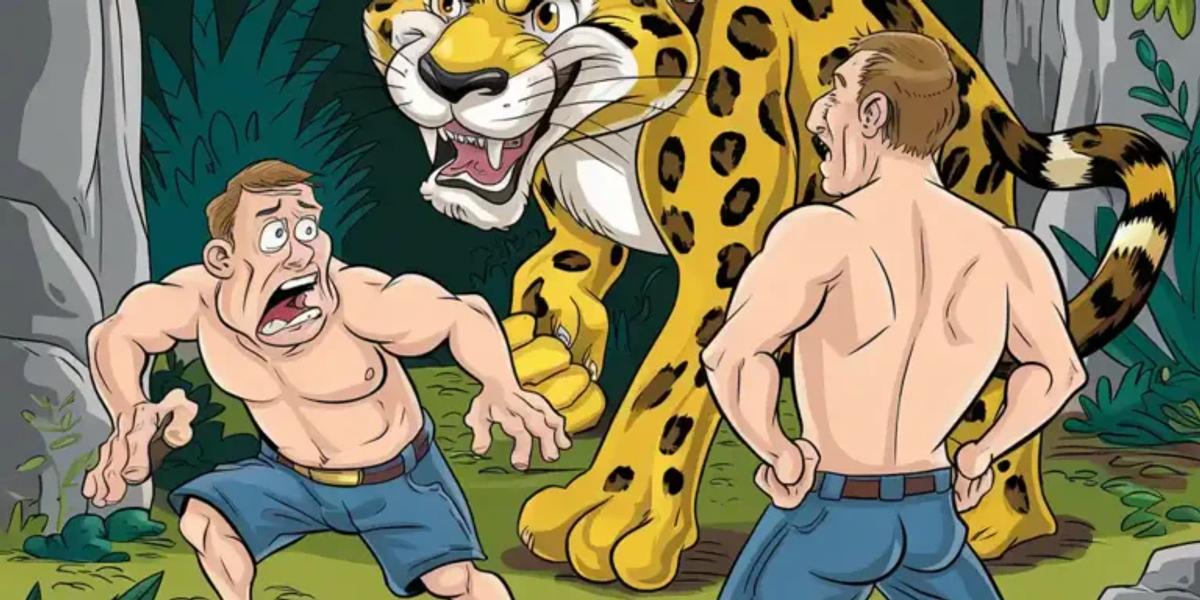
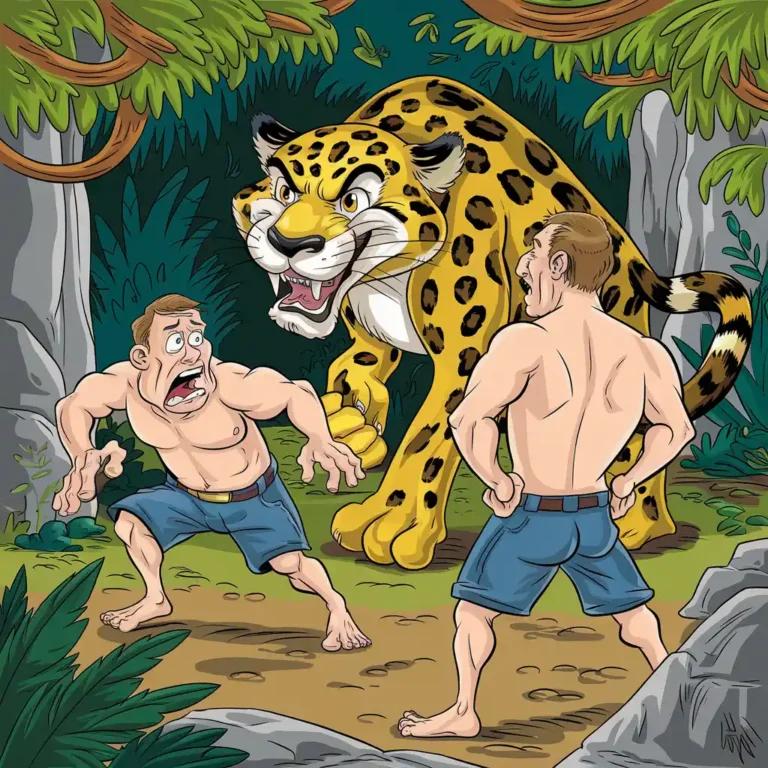
Imagine walking into a dense forest. Sunlight filters through the canopy. The scene is peaceful — until a jaguar appears. It locks eyes with you. Its spotted coat ripples over a powerful, dangerous frame. Your heart skips a beat, and something ancient in you takes over.
In that moment, your hypothalamic-pituitary-adrenal axis fires faster than conscious thought. This is not a catchy phrase — it is your evolutionary inheritance in action. Adrenaline and noradrenaline flood your system. Your heart pounds. Your blood vessels constrict. You sweat. Every system in your body now has one priority: survival.
You run. Of course you do. Our ancestors who responded quickly to threats like this lived to pass those traits on. We are, quite literally, the descendants of excellent stress responders.
Designed to Survive: The Body's Emergency Blueprint
When the jaguar appears, a cascade of events unfolds in milliseconds. The hypothalamus — that ancient control centre deep in the brain — fires like a starting pistol. The adrenal glands release adrenaline and noradrenaline. Heart rate accelerates. Blood is redirected to the muscles of your legs and arms. Pupils dilate. Breathing quickens. Even your blood's clotting ability increases, preparing for potential injury.
Your digestive system slows to a crawl — who needs to digest lunch when there is a jaguar nearby? And your reproductive function takes a complete backseat. Every drop of blood, every molecule of oxygen, every unit of glucose is diverted to systems essential for immediate survival.
(A small aside: ever wondered why extreme fear might make you need the bathroom? Your body is literally shedding unnecessary weight. It is not embarrassing — it is evolutionary brilliance.)
A Tale of Two Ancestors
Imagine two early humans in the same jungle. One is our direct ancestor. The other is their evolutionary cousin. When the jaguar appears, our ancestor's adrenaline surges — heart racing, muscles tensing, legs ready to run.
The cousin's body responds differently. Instead of fight-or-flight, blood flows to his reproductive organs. He prioritises reproduction over escape. The jaguar has its meal. Our ancestor survives, and over generations, natural selection refines the stress response into the efficient system we carry today.
Now bring this into the modern world. The jaguar is gone — but your body does not know that. Every significant stressor — unpaid bills, a looming deadline, a difficult conversation — registers as a threat. The stress circuitry does not distinguish between predators and perceptions.
The result? Stress-induced erectile dysfunction becomes as physiologically real as if a jaguar were chasing you. Stress hormones surge, blood flow is redirected away from the penis, and the conditions for a healthy erection simply do not exist. This is not a character flaw. It is an inconvenient consequence of a very successful evolutionary design.
The Modern Jungle: Invisible Jaguars Everywhere
Your body's threat-detection system, refined over millions of years, cannot reliably distinguish between a jaguar and a difficult conversation you are dreading. That is not a design flaw — it is the cost of having a system sensitive enough to keep you alive.
Try this. Close your eyes and imagine receiving a message that says: "We need to talk." Can you feel it? That subtle tightening in your chest, the slight acceleration of your heartbeat? Your hypothalamic-pituitary-adrenal axis just activated — identically to how it would if you were facing our jungle friend.
Clinical note: Functional MRI studies show that the anterior cingulate cortex displays identical activation patterns during both physical and psychological threat exposure.
Our ancestors might have encountered a jaguar once a month. Your brain now processes dozens of psychological threats every single day. The deadline over your shoulder. The relationship conversation you are avoiding. The financial worry that wakes you at 3am. Your amygdala — the brain's threat detector — responds to each of these with the same fundamental programme: prepare for survival.
The Psychological Shift: From Predators to Perceptions
Anticipatory Anxiety: When the Mind Sees Jaguars That Are Not There
Here is where it becomes particularly relevant to erectile dysfunction. Your brain does not only respond to present threats or perceived ones — it can activate the entire stress cascade simply by imagining future possibilities. This is anticipatory anxiety: the fear not of what is, but of what might be.
Your hippocampus pulls out every relevant past experience. Your prefrontal cortex games out future scenarios. Your anterior cingulate cortex amplifies the concern. And suddenly, your body is preparing for a jaguar encounter that has not happened, is not scheduled, and probably never will.
Clinical note: Anticipatory anxiety can trigger cortisol elevations of 35–50% above baseline — measurable through salivary cortisol testing — even in the complete absence of actual stressors.
We have just described the psychogenic cascade leading to erectile dysfunction.
The Preview Paradox: Fear Creates Reality
In the context of sexual intimacy, this creates what I call the Preview Paradox. The brain supplies memories of past difficulties. This triggers the stress response. Blood flow diverts away from the reproductive system. The very thing you feared might happen — happens. Which then becomes a new memory for the hippocampus to file away, ready for next time.
Understanding this cycle is the first step to breaking it. If your body can learn to fear imaginary jaguars, it can also learn to recognise when there is genuinely nothing to fear.
The Intersection of Stress and Sexuality
To understand how erections fail, we first need to understand how they work. Bear with me — this is where the physiology becomes genuinely elegant.
How an Erection Actually Works
The erectile mechanism is one of the body's most precisely engineered systems. It depends on an interplay of blood vessels, smooth muscle, and neural signals working together with remarkable coordination. Like a well-conducted piece of music, each component plays its part at exactly the right moment — and the whole thing is surprisingly vulnerable to disruption.
Step 1: The Parasympathetic System Takes the Lead
Your parasympathetic nervous system — the body's "rest and restore" department — initiates the process. Its first action is releasing nitric oxide (NO), a molecule so central to this mechanism that its discovery earned a Nobel Prize. (Yes, this is the same pathway targeted by those well-known blue tablets.)
Clinical pearl: Think of nitric oxide as the conductor's baton — one subtle signal that sets the entire process in motion.
The biochemical cascade that follows: nitric oxide triggers cyclic guanosine monophosphate (cGMP) production. cGMP relaxes smooth muscle. Blood flow into the penis increases — by up to 580% at peak arousal.
Step 2: The Anatomy Does Its Work
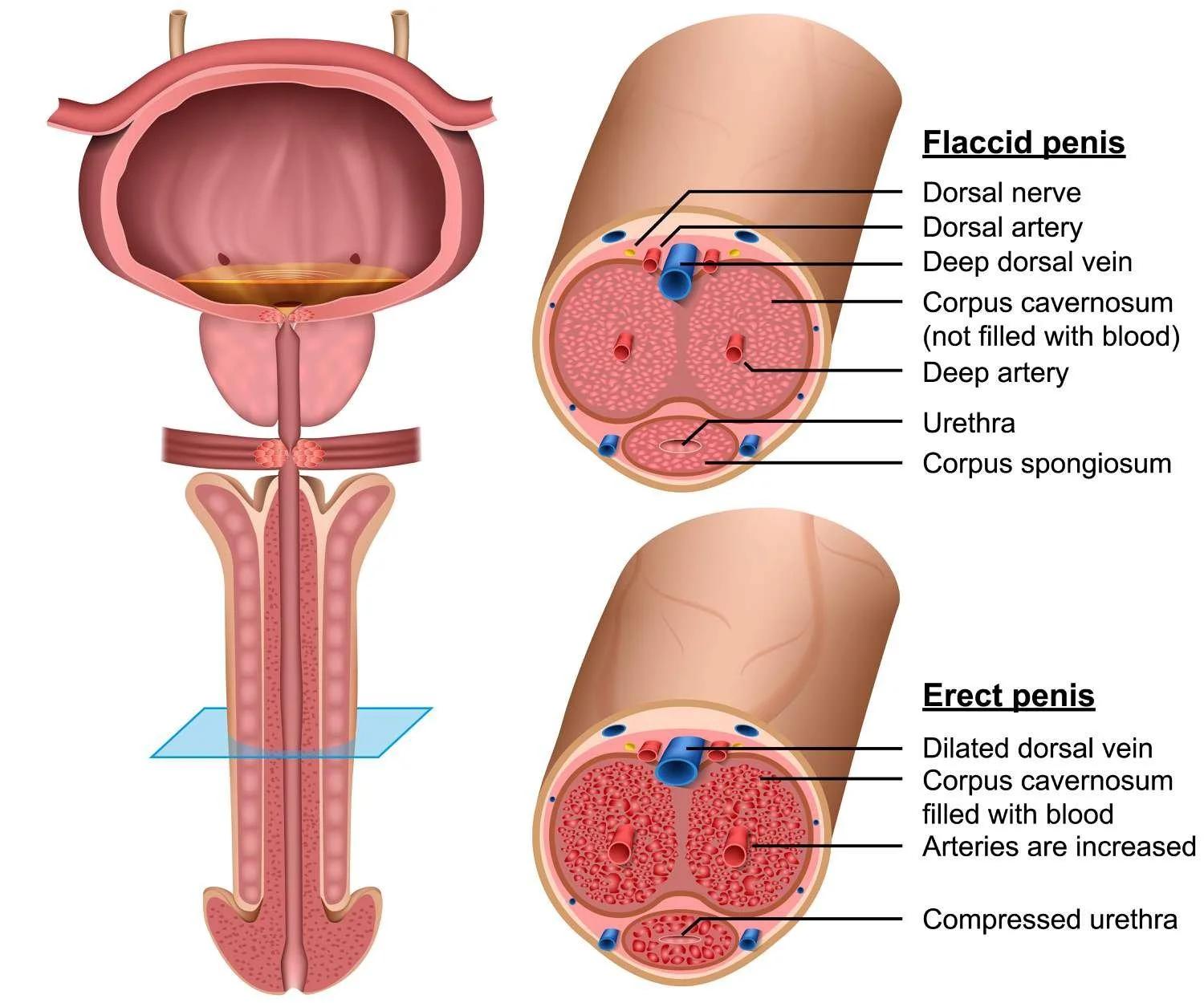
The penis contains two parallel cylindrical structures — the corpora cavernosa — enclosed by a tough, fibrous, largely inextensible layer called the tunica albuginea. Specialised coiled vessels called helicine arteries supply blood to these chambers. Their coiled design is pure engineering: they can accommodate dramatically increased blood flow without structural damage.
Step 3: The Trapping Mechanism
As the chambers fill with blood, the expanding tissue compresses the outgoing veins against the tunica albuginea. This creates a natural one-way valve — blood is trapped inside the corpora cavernosa. High-pressure fluid, contained by an inextensible layer: the result is a sustained, rigid erection.
The Natural Progression
The erectile response moves through distinct phases. Arousal: the parasympathetic system initiates the sequence, blood flows in, tissue fills and firms. Plateau: the erection reaches full development, maintained by continued parasympathetic dominance. Ejaculation: the sympathetic system takes command, triggering ejaculation and immediate vascular release. Blood flows out, and the tissue returns to rest.
Understanding this progression helps us appreciate how stress can interrupt any stage of the process.
When the Jaguar Crashes the Process
When anxiety strikes — when the brain detects a "jaguar", real or imagined — it activates what I think of as the body's emergency broadcast: the sympathetic surge.
Adrenaline floods the system. Blood vessels constrict. Blood flow is redirected to the large muscle groups — excellent for running, entirely counterproductive for intimacy. Cortisol levels rise sharply. Nitric oxide production falls. The conditions for an erection simply cease to exist.
Clinical note: Acute stress can reduce penile blood flow by up to 70% within seconds. Most men have experienced a version of this — the immediate loss of erection when an unexpected phone call interrupts a private moment. That instant detumescence demonstrates exactly how rapidly the sympathetic system can override sexual arousal when the brain perceives a social threat.
And here lies the paradox. The very system designed to protect you from harm can sabotage one of the most intimate, vulnerable moments of your life. Your body, in its eagerness to defend, mistakes closeness for crisis, desire for danger.
Unlike our ancestors, who faced jaguars in brief, life-or-death encounters, our modern stressors linger — not for minutes, but for hours, days, sometimes years. The result is a body chronically primed for survival at the expense of pleasure, connection, and confidence.
Dancing with the Jaguar: Understanding Stress to Take the Lead
So, what now? If the stress response is this deeply wired, does that mean anxiety will always dictate our intimate lives? Is psychogenic erectile dysfunction simply untreatable?
Not at all.
In the next part of this series, we will explore how to rewire the alarm system, retrain the body, and reclaim control. Because while the jaguar may be imaginary, the solution is very real.

Part 2: The Jaguar's Reach — Performance Anxiety and the Epidemiology of ED
You Are Not Alone
The stress response described in Part 1 is not a rare quirk. It is the exact physiological mechanism behind sexual performance anxiety for millions of men worldwide. If you have struggled with erectile dysfunction linked to performance pressure, here is something that may genuinely shift your perspective: you are not alone. You are experiencing one aspect of a global health challenge affecting hundreds of millions of men across every demographic.

The Scale of the Problem
By 2025, erectile dysfunction is estimated to affect 322 million men worldwide — more than double the 152 million affected in 1995. To put that in perspective: if erectile dysfunction were a country, it would be the fourth most populous nation on Earth.
This is not merely a statistic. It is a silent epidemic with real consequences for intimate relationships, mental health, self-confidence, and quality of life.
Understanding the scale matters because it normalises the experience. The question shifts from "what is wrong with me?" to "how do I manage this common physiological response?"
Age Is Not the Whole Story
For decades, erectile dysfunction was considered primarily an older man's problem. That assumption is no longer tenable. The Massachusetts Male Aging Study confirmed that 52% of men between 40 and 70 experience some degree of ED — but more recent data shows unexpectedly high prevalence in men under 40, rewriting the medical narrative entirely.
Why Younger Men Are Affected
The sympathetic nervous system does not check your age before activating. In fact, younger nervous systems may be more sensitive to perceived threats — think of stage fright, which often affects younger performers more acutely than seasoned ones. The same principle applies to sexual performance anxiety.
Recent UK surveys suggest that six in ten young British men actively avoid sexual encounters because of performance anxiety.
They are not experiencing occasional nervousness. They are avoiding the jungle entirely, for fear of the jaguar.
The Jaguar Does Not Discriminate
The physiological stress response does not vary by sexual orientation — but it manifests differently across populations. Studies consistently show higher rates of psychogenic erectile dysfunction among gay men compared to heterosexual men. The contributing factors include heightened performance pressure in same-sex encounters, minority stress from chronic social stigma, and different patterns of intimacy and partnership.
Neurophysiology note: The amygdala cannot distinguish between physical danger and social anxiety. It activates the same stress cascade either way.
Interestingly, studies also show that gay men are 28% less likely than heterosexual men to report premature ejaculation — suggesting that different relationship dynamics shape different sexual patterns in both directions.
Gender Identity and Sexual Function
For transgender individuals, the picture is more complex. Using the Arizona Sexual Experiences Scale, researchers found that 92.3% of transgender women and 87.8% of transgender men reported sexual dysfunction before gender transition. Among transgender women specifically, 23% reported problems with erections before transition, while orgasm satisfaction was a significant concern across both groups.
The interplay of hormonal factors, body image concerns, gender dysphoria, and surgical considerations makes this a genuinely complex area — one that requires inclusive, individualised care.
The Nocebo Effect: When Expectation Becomes Reality
What if you unintentionally summon the jaguar through negative expectation alone? This is the nocebo effect — the mirror image of placebo. Just as positive expectation can produce real physiological benefit, negative expectation can produce real physiological dysfunction.
If you expect erectile difficulties, your sympathetic nervous system activates preemptively — physiologically blocking an erection before the situation has even developed. Over time, this self-reinforcing cycle can transform temporary anxiety into chronic erectile dysfunction, even in the complete absence of physical causes.
Clinical insight: In my practice, I have seen many patients whose erectile dysfunction began with a single disappointing experience — one that created a cascade of anticipatory anxiety, perpetuating the very problem they feared. The first episode was often entirely situational. What followed was the cycle.
Social context matters too. Performance anxiety and erectile dysfunction cluster in environments with rigid sexual norms, unrealistic expectations, or poor sexual health literacy.
The Digital Jaguar
Modern life has introduced new threats into the metaphorical jungle — ones our ancestors never faced. Younger generations are experiencing record levels of performance anxiety, and the rise of digital media is a significant contributing factor.
Pornography creates an idealised, professionally curated version of sex that is impossible to replicate in real life. Constant digital stimulation — the dopamine-driven nature of social media and gaming — keeps the brain in a state of low-level arousal and stress, making genuine relaxation during intimacy difficult. And the sheer volume of health information available online can create hypervigilance about sexual performance that becomes self-defeating.
A constantly stimulated, performance-focused mind creates the ideal conditions for the jaguar response to activate at precisely the wrong moment.
Breaking the Cycle
Understanding how to address performance anxiety erectile dysfunction begins with recognising it as a normal physiological response — not a personal failing. The strategies that work do so because they target the underlying mechanism:
- Mindfulness techniques that deactivate the sympathetic nervous system
- Cognitive behavioural approaches that interrupt the anticipatory anxiety cycle
- Partner communication exercises that reduce performance pressure
- Gradual exposure approaches that rebuild sexual confidence
Clinical perspective: In my experience, patients who understand the jaguar response as a normal physiological reaction — rather than a personal failure — recover more quickly and more completely from sexual performance anxiety. The reframe matters.
The Relationship Factor
Sexual function does not exist in isolation. It is embedded in relationships, and relationships shape the threat landscape. High performance anxiety correlates with lower relationship satisfaction. Increased erectile dysfunction risk correlates with higher relationship stress.
Psychological safety is a prerequisite for sexual confidence. If the relational environment consistently triggers stress, the sympathetic system remains active — making spontaneous arousal nearly impossible. In evolutionary terms, this makes sense: sex is inherently social, and we are wired to seek safety before vulnerability.
From Epidemiology to Empowerment
Recognising that millions of men experience performance anxiety is not just interesting — it is genuinely liberating. The epidemiology of erectile dysfunction reveals its fundamental nature: not a random malfunction, not a personal failing, but a predictable neurophysiological response to modern stressors. And that means it is manageable — with the right approach, matched to the right mechanism.
If you want to understand whether your erectile dysfunction has a physical component — vascular, structural, or otherwise — a penile Doppler ultrasound can provide objective data that changes the conversation entirely. And if venous leak is part of the picture, that too is a diagnosable and treatable condition.
What's Coming in Part 3: Taming Your Jaguar
In the next instalment, we will explore scientifically validated strategies for working with your body's natural responses rather than against them. Practical techniques for deactivating the sympathetic nervous system on demand, breaking the anticipatory anxiety cycle, building resilience against performance pressure, and creating the conditions — physical and psychological — for genuine sexual confidence.
- Deactivating your sympathetic nervous system on command
- Breaking the anticipatory anxiety cycle
- Building resilience against performance pressure
- Creating the optimal physical and psychological environment for sexual confidence
Want to Take the Next Step?
Subscribe to my newsletter for the latest insights on sexual health and performance anxiety.
If you are ready to understand what is driving your erectile dysfunction — and to match treatment to the actual mechanism rather than guesswork — I am here.