

My clinic letters are too long on purpose
If you have ever had a letter from me after a consultation, you may have noticed it is longer than most. That is deliberate.
I do not write those letters for my records. I write them for you. I want a trace — of what we discussed, why I suggested what I suggested, what we decided together, and what happens next. Months later, when the conversation has blurred, the letter is still there, saying the same thing it said on the day.
For a long time that was my whole system: talk properly in the room, then write it all down so nothing important disappears. It works. But it only covers half of the problem — and it took me a while to see the other half clearly.
I forget most of what my own doctor tells me
Here is something I say to my patients, and I mean it: I am a doctor, and when I sit on the other side of the desk as a patient, I forget about 80% of what I am told the moment I walk out of the door.
Not because the doctor was bad. Not because I was not listening. It is just how attention and memory work when you are the one being examined — a bit anxious, processing the news, thinking three questions ahead while the doctor is still on the first answer.
I joke about it in clinic: if it happens to me, it is almost certainly happening to you — maybe more. And patients laugh, because they recognise it. Then they relax a little, because the thing they were quietly embarrassed about — I cannot remember what he said — turns out to be completely normal.
And this is not just my impression. When patient recall is actually measured after surgical consultations, people remember only a fraction of what they were told. The risks and the alternatives fade first, and what is left keeps fading over the following weeks. The information was given. It just did not stay.
There is a legal edge to this too, which matters more than people realise. Since a landmark UK ruling, consent is officially more than a signature on a form: a risk counts as one you should have been told about if a reasonable person in your position would attach significance to it. In other words, consent is not the signature — it is the understanding. And understanding is exactly the part that quietly leaks away.
Now imagine the same thing after surgery
If that is what happens in a calm clinic, on a good day, with nothing hurting — think about what happens after an operation.
You have just had surgery. You are sore. You might be a bit shaken. You are worried about something specific and practical — in my world, often how am I going to pass urine, or is this meant to look like this. And it is in exactly that state, distracted by pain and worry, that we hand over the discharge instructions.
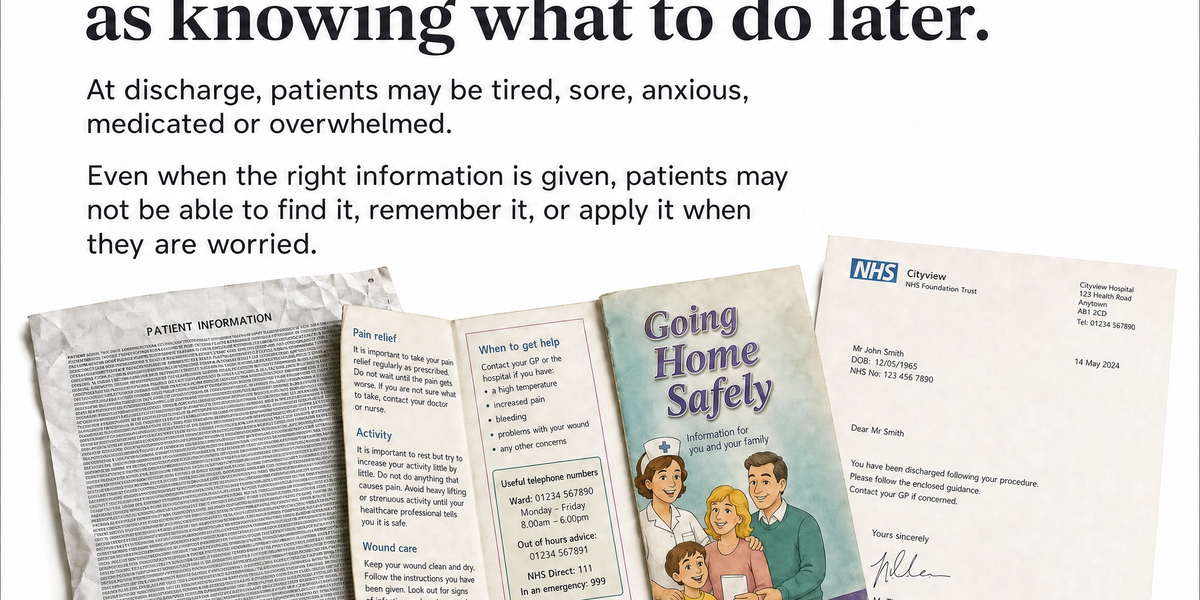
So the amount that actually lands is even smaller than in clinic. When this was pooled across more than fifty studies of hospital discharge, patients correctly recalled, on average, under half of spoken instructions. Writing it down helped, but only lifted it to around six in ten; even video only reached about two-thirds. And the more distressed a person is — or the harder the information is to read — the more is lost.
That last point is not a small one. In England, more than four in ten working-age adults struggle to understand everyday health information, rising to around six in ten once numbers are involved. The NHS aims for patient material written at a reading age of nine to eleven — yet a great deal of it, mine included in the past, is pitched far higher. More than a third of surgical patients have limited health literacy. So the standard leaflet often fails twice: it arrives at the worst moment, and it is written above the level of the person holding it.
Let me show you how that plays out — the same weekend, seen from three sides.
Nobody in that story did anything wrong. And yet everyone had a worse week than they needed to. The information that would have defused the whole thing existed — it just was not where the patient was, in the form he needed, at 11pm on a Tuesday when the fear arrived.
The honest truth I had to accept
Here is what I eventually admitted to myself: no matter how well I explain things, you will never remember everything I say. And no matter how long I make the letter, I can never write down everything I know.
The two limits I cannot explain my way past
You will not remember everything I tell you — and I cannot write down everything I know. Both are built in. A better consultation and a longer letter help, but they do not close the gap.
So the question stopped being how do I explain better? and became how do I make the right information findable at the moment the worry actually shows up? And there the evidence is encouraging: when patients are given clear, structured information they can go back to — including simple formats like short videos — their understanding measurably improves. In one trial of men recovering from a procedure I perform often, those given video guidance understood their aftercare significantly better than those handed the usual written sheet.
What I built instead
That question is why I created two things.
Polaris is for before — the pre-operative side. It is a structured, plain-language way of laying out what a procedure involves, the risks that genuinely matter to you, and the decisions we are making, so the consultation is not the only time you get to absorb it. It is my long clinic letter, grown up: something you can go back to when you are calmer, not something that flashes past once in a room.
Compass is for after — the recovery side. It is the thing that should have been there on that Tuesday night: clear, accessible, always-available guidance on what is normal, what is not, and exactly when and how to raise the alarm — so a normal bruise reads as a normal bruise, and a genuine red flag gets acted on fast. Not fifteen generic lines. A companion for the days when you are sore and worried and the clinic is closed.
Neither replaces me, the consultation, or the letter. They exist because I know the limits of all three — and because I would rather build the safety net than pretend the gap is not there.
Frequently asked questions
Yes — absolutely. Forgetting some of it is normal, and it is exactly why I write things down and give you something to go back to. Ask everything. Nothing you bring is too small or too embarrassing.
A leaflet is a start, but it is usually short and general, and it reaches you at the worst moment for taking things in. That is not a criticism of leaflets — it is the reason I built something you can return to when you actually need it.
Do not sit alone with it and do not rely on a late-night search. Use the recovery guidance you have been given, and if something matches a red flag — or you simply cannot settle the worry — contact the clinic. That is what we are here for.